
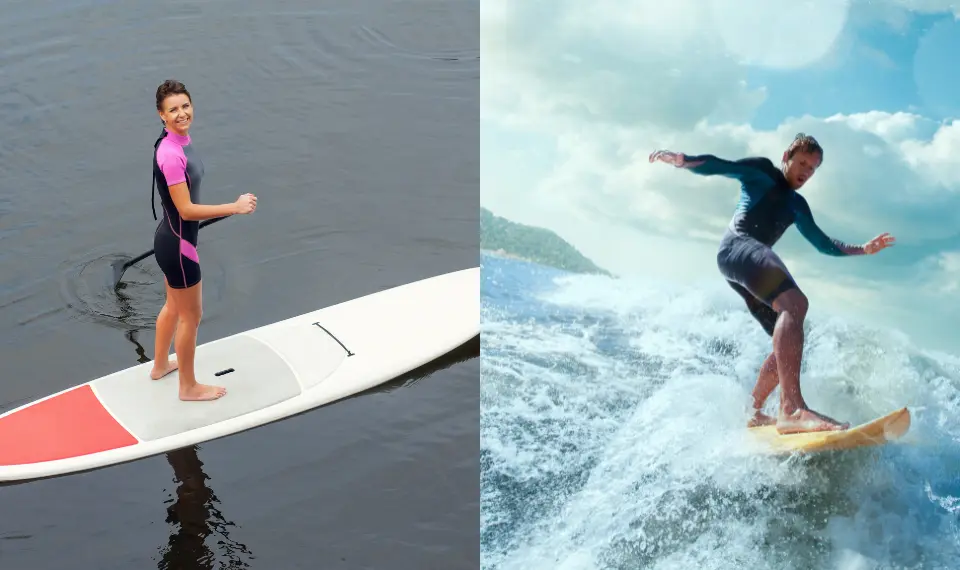
If you’re interested in trying a board sport for the first time, one question often comes up: paddle boarding vs surfing, which is easier? Both activities take place on the water and offer exciting experiences, but they require different skills, conditions, and learning curves. Understanding the differences can help you choose the activity that best matches your confidence, fitness level, and goals.
Paddle Boarding vs Surfing: Understanding the Basics
When comparing paddle boarding vs surfing, the biggest difference is how each sport works.
Stand up paddle boarding involves standing on a larger, more stable board while using a paddle to move through the water. It can be enjoyed on calm lakes, rivers, lagoons, and oceans.
Surfing, on the other hand, depends on catching moving waves without a paddle. Timing, wave selection, and balance all play important roles, making the sport more technical from the beginning.
Although both use similar-looking boards, the overall experience is quite different.
Which Sport Is Easier for Beginners?
For most people, paddle boarding is easier to learn.
A beginner can usually stand up and start paddling after a short introduction in calm water. The wide board provides stability, allowing new paddlers to focus on balance without worrying about incoming waves.
Surfing typically requires more practice before reaching the same level of confidence. Beginners need to learn how to paddle through waves, pop up quickly, and maintain balance while the board is moving.
This difference in learning speed is one of the main reasons many people choose paddle boarding as their first board sport.
Water Conditions Make a Big Difference
Another important factor in the paddle boarding vs surfing comparison is the environment.
Paddle boarding works well in calm conditions. Quiet bays, lakes, and protected beaches create ideal locations for beginners to practice safely.
Surfing depends on suitable waves. If conditions are too small, catching waves becomes difficult. If the waves are too large, beginners may find the experience intimidating.
Because paddle boarding offers more flexibility in location, it is often easier to enjoy throughout the year.
Equipment and Stability
The design of the board also affects how quickly beginners progress.
SUP boards are generally wider, longer, and thicker than surfboards. This additional stability makes standing and balancing much easier during the first few sessions.
For people planning to continue the sport, it is worth taking time to shop stand up paddle board options that suit different experience levels. Choosing the right board from the beginning often makes learning smoother and more enjoyable.
Surfboards are built for maneuverability on waves, not stability on flat water. This makes balancing more challenging until proper technique develops.
Fitness Requirements
Both sports provide excellent exercise, but they challenge the body in different ways.
Paddle boarding offers a steady full-body workout that improves balance, core strength, and endurance without requiring explosive movements.
Surfing involves repeated paddling, fast pop-ups, quick turns, and constant movement in changing wave conditions. It often demands greater upper-body strength and cardiovascular endurance during the learning phase.
People looking for moderate exercise usually find paddle boarding less physically demanding while still providing noticeable fitness benefits.
Safety for First-Time Participants
Safety is another reason many beginners start with paddle boarding.
Learning on calm water reduces many of the challenges associated with ocean waves. New paddlers can practice balance, turning, and paddling at their own pace without constantly reacting to changing surf conditions.
If you’re traveling and want to try the activity without purchasing equipment, SUP Board Rentals in Bali provides an easy way to experience paddle boarding using boards suited for beginners.
As with any water sport, wearing appropriate safety gear and checking local weather conditions remain important.
Which Activity Offers More Variety?
The paddle boarding vs surfing discussion is not only about difficulty. It also depends on the type of experience you’re looking for.
Paddle boarding allows people to explore coastlines, rivers, lakes, mangroves, and lagoons. Some enjoy peaceful sunrise paddles, while others combine the activity with photography, fitness, or nature exploration.
Surfing focuses on riding waves. Every successful wave brings excitement, but the experience depends heavily on surf conditions.
Many outdoor enthusiasts eventually enjoy both sports because each offers something unique.
So, Which One Should You Choose?
If your goal is learning quickly and enjoying time on the water with minimal frustration, paddle boarding is generally the better starting point.
It provides a stable platform, works in more locations, and allows beginners to build confidence step by step. Surfing remains an exciting challenge, but it often requires more patience and practice before new participants feel comfortable.
Starting with paddle boarding can also make the transition to surfing easier later by improving balance and overall confidence on the water.
Conclusion
The answer to paddle boarding vs surfing depends on your expectations, but for most beginners, paddle boarding is the easier option. It offers a gentler learning curve, greater stability, and more flexibility in terms of locations and water conditions.
Surfing rewards persistence with the thrill of riding waves, while paddle boarding provides a relaxing combination of recreation, fitness, and exploration. If you’re deciding which sport to try first, paddle boarding is an excellent introduction to life on the water and a skill that can lead to many new adventures.